
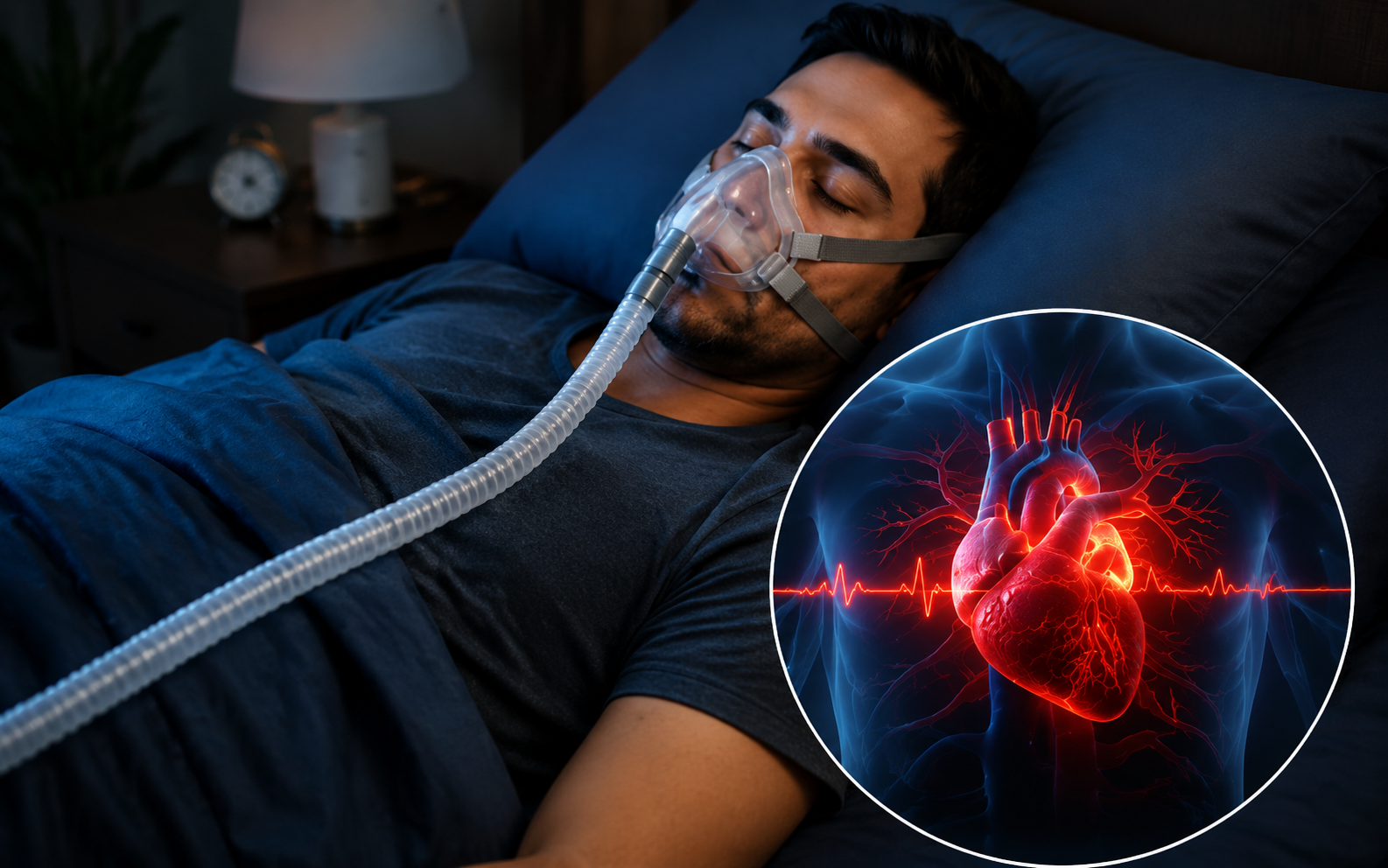
When most people think about Sleep Apnea, they think about snoring and tiredness. What they rarely consider is what is happening to their heart while they sleep.
The link between Sleep Apnea and cardiovascular disease is one of the most well-established connections in sleep medicine — and it is serious enough that cardiologists now routinely screen their patients for it. If you have Sleep Apnea and it remains untreated, you are not just losing sleep. You are placing your heart under repeated, measurable stress every single night.
What Happens to Your Heart During a Sleep Apnea Episode?
- Breathing stops for 10 to 30 seconds or longer
- Oxygen levels in the blood drop sharply (hypoxia)
- The body triggers an emergency stress response, releasing adrenaline
- Heart rate and blood pressure spike suddenly
- You partially wake up, breathing restarts — and the cycle repeats
This sequence can happen 50 to 100 times per night. Each episode is essentially a cardiovascular stress test. Night after night, year after year, this takes a significant toll.
The Cardiovascular Risks of Untreated Sleep Apnea
1. High Blood Pressure (Hypertension)
Research consistently shows that more than half of Sleep Apnea patients also have hypertension. More importantly, treating the Sleep Apnea often improves blood pressure control — sometimes reducing or eliminating the need for medication. Patients taking antihypertensives without addressing Sleep Apnea may find their medication underperforms precisely because of the nightly pressure spikes.
2. Atrial Fibrillation (AFib)
AFib — an irregular, often rapid heart rhythm — is a leading cause of stroke. Studies show that people with Sleep Apnea have a two to four times higher risk of developing AFib. The repeated drops in oxygen and the autonomic nervous system disruptions caused by apnea events directly contribute to this arrhythmia.
3. Heart Attack
Large-scale studies have found that people with severe untreated Sleep Apnea have a significantly elevated risk of heart attack — particularly during the early morning hours, when REM sleep (and therefore apnea events) is most concentrated.
4. Stroke
The combination of blood pressure spikes, oxygen deprivation, and AFib creates a dramatically elevated stroke risk. This risk is especially pronounced in adults over 50 and in those who already have other cardiovascular risk factors.
5. Heart Failure
Sleep Apnea and heart failure share a bidirectional relationship — each condition worsens the other. Fluid buildup associated with heart failure can narrow the airway, and the oxygen drops from Sleep Apnea put additional strain on an already compromised heart.
Beyond the Heart: Other Health Consequences
Metabolic Impact
Sleep Apnea promotes insulin resistance, raising the risk of Type 2 Diabetes. For those already managing diabetes, untreated Sleep Apnea makes blood sugar control significantly harder.
Weight Gain
Sleep deprivation from apnea disrupts hunger-regulating hormones, increasing appetite — particularly for high-calorie foods. Weight gain, in turn, worsens Sleep Apnea by adding fatty tissue around the airway. This creates a self-reinforcing cycle that is difficult to break without treating the sleep disorder directly.
Mental Health
Chronic oxygen deprivation during sleep alters brain chemistry. The links between untreated Sleep Apnea and depression, anxiety, and accelerated cognitive decline are well-documented in medical literature.
How Your Dentist Fits Into the Picture
Your dentist is often the first healthcare provider in a position to identify Sleep Apnea risk. During a routine examination, a trained dentist can assess jaw structure, tongue size, palate anatomy, and other oral features that may signal airway compromise.
For patients with Obstructive Sleep Apnea, a custom oral appliance can reduce apnea events, stabilize oxygen levels through the night, and decrease the cardiovascular burden that untreated Sleep Apnea creates. For patients who cannot tolerate CPAP, it is often the single most effective treatment available.
When Should You Talk to Your Dentist?
- You or your partner notices snoring or breathing pauses during sleep
- You have high blood pressure that is difficult to control
- You have been diagnosed with AFib or another heart arrhythmia
- You already have a Sleep Apnea diagnosis but struggle to use your CPAP
- You wake feeling unrefreshed despite adequate hours of sleep
📞 Your dental health and your heart health are more connected than you might think. Ask us about Sleep Apnea screening at your next visit — it could be one of the most important conversations you have.
